
Hyeong Jun Lee
I work across computational hemodynamics, physics-informed AI, wearable biosignals and medical devices.
Postdoctoral Researcher, Multiscale Fluid Dynamics Lab, School of Mechanical Engineering, Yonsei University
Project Researcher, Yonsei University Health System, 4D CT-FFR project
- hjunlee96@gmail.com
- Google Scholar
- ORCID
- hyeongjunlee.me
Education
- Mar. 2020 – Aug. 2026
Ph.D. in Mechanical Engineering (Integrated M.S.–Ph.D. Program) Yonsei University, Seoul, Republic of Korea
- Mar. 2016 – Feb. 2020
B.Eng. in Mechanical Engineering Pusan National University, Busan, Republic of Korea
Appointments
- Sep. 2026 – Present
Postdoctoral Researcher, Multiscale Fluid Dynamics Lab (PI: Prof. Joon Sang Lee) Yonsei University, Seoul, Republic of Korea
- Mar. 2020 – Aug. 2026
Graduate Research Assistant, Multiscale Fluid Dynamics Lab (Advisor: Prof. Joon Sang Lee) Yonsei University, Seoul, Republic of Korea
- Jan. 2021 – Jun. 2021
Research Intern E8 (E8IGHT Co., Ltd.), Seoul, Republic of Korea
Publications
4 journal articles · 2 proceedings · 1 under revision · † first author · * corresponding author
Journal articles (SCIE)
Peer-reviewed proceedings
Manuscript under revision
-
Multi-Model Deep-Learning Ensemble for Predicting 24-Hour Fluid Bolus Administration from Continuous Photoplethysmography Spectrogram Analysis
Talks
-
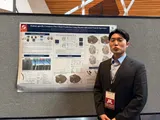
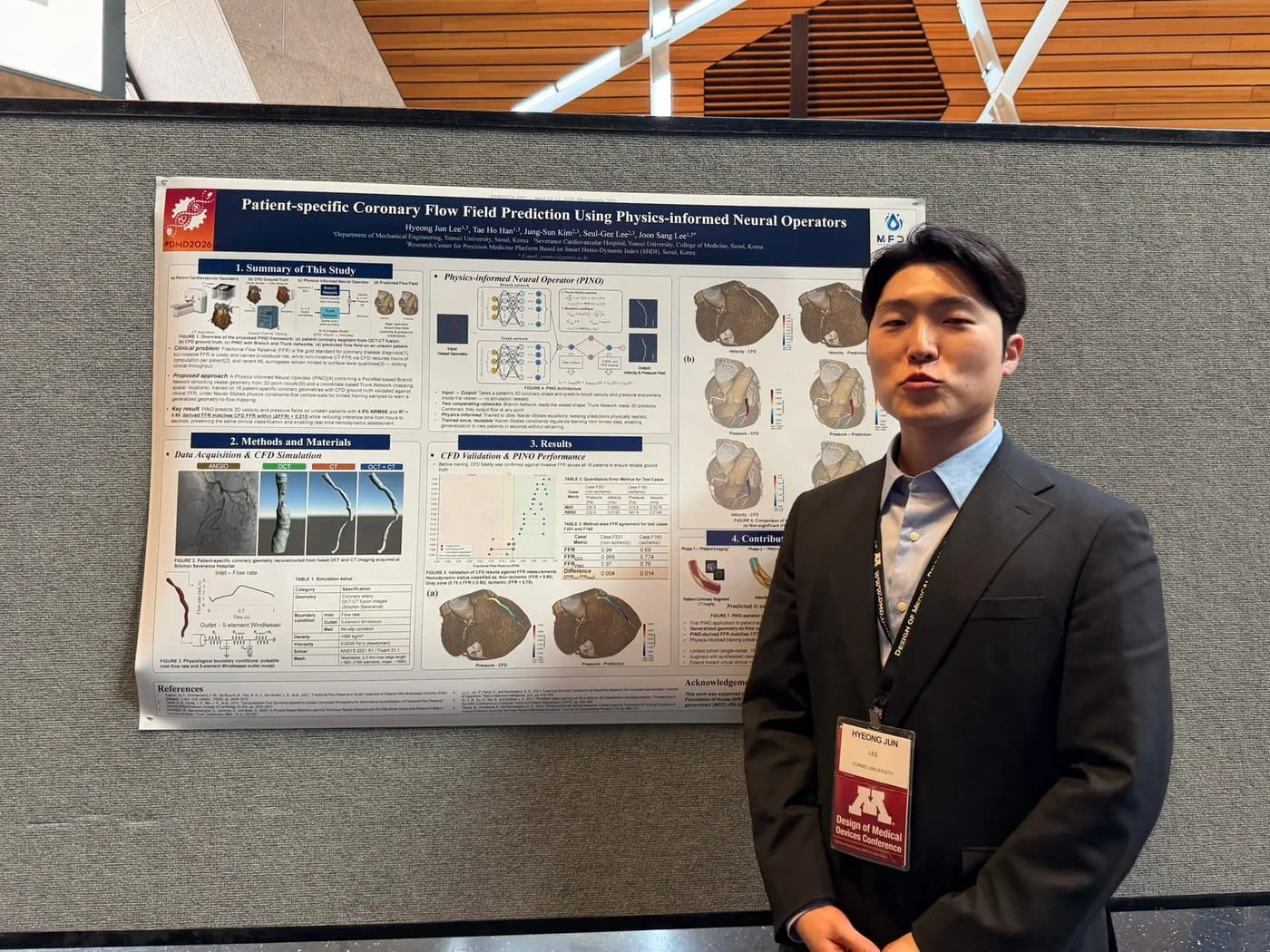
DMD 2026 · Poster -
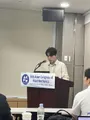
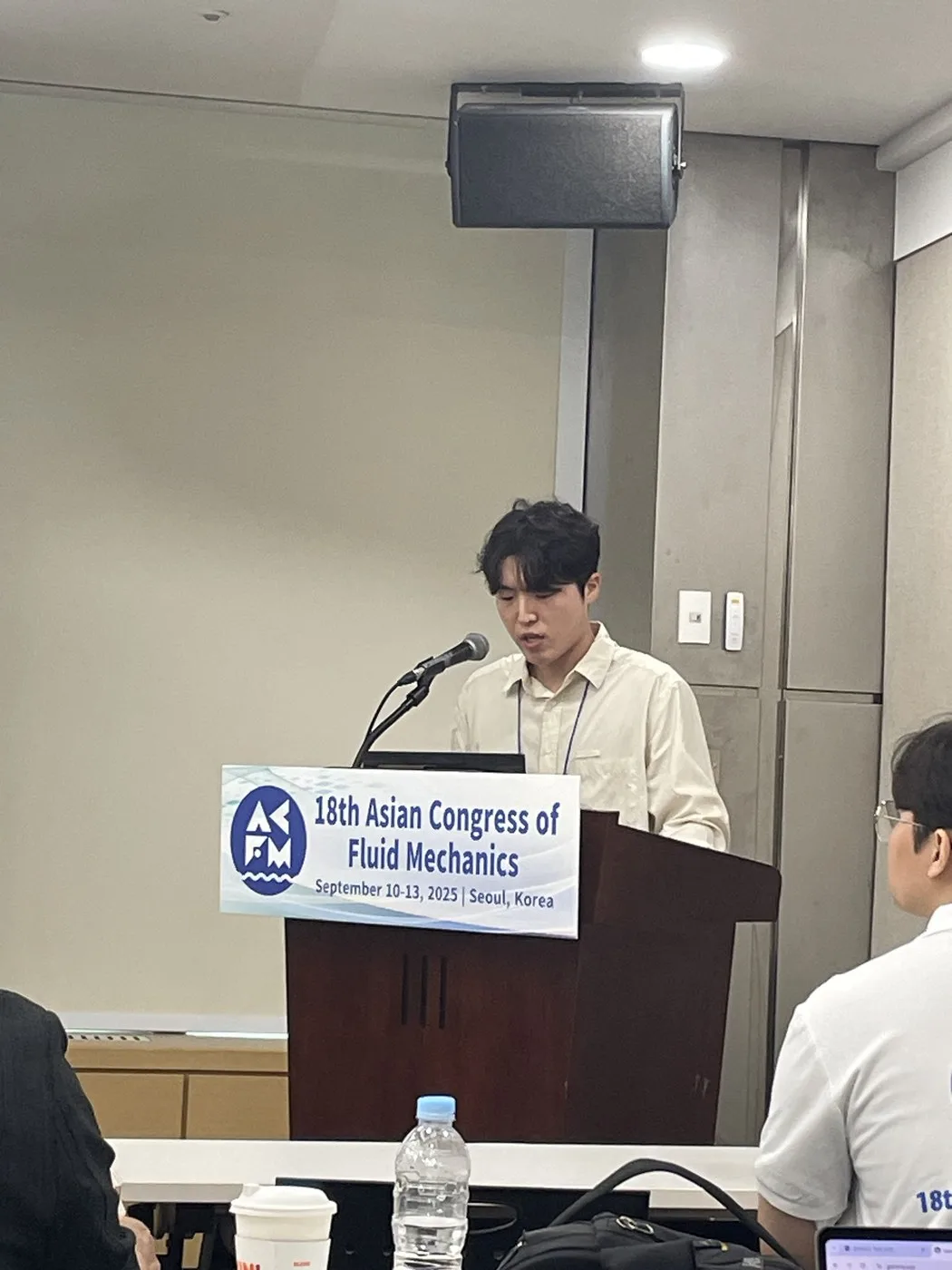
ACFM 2025 · Oral -
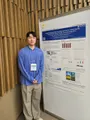
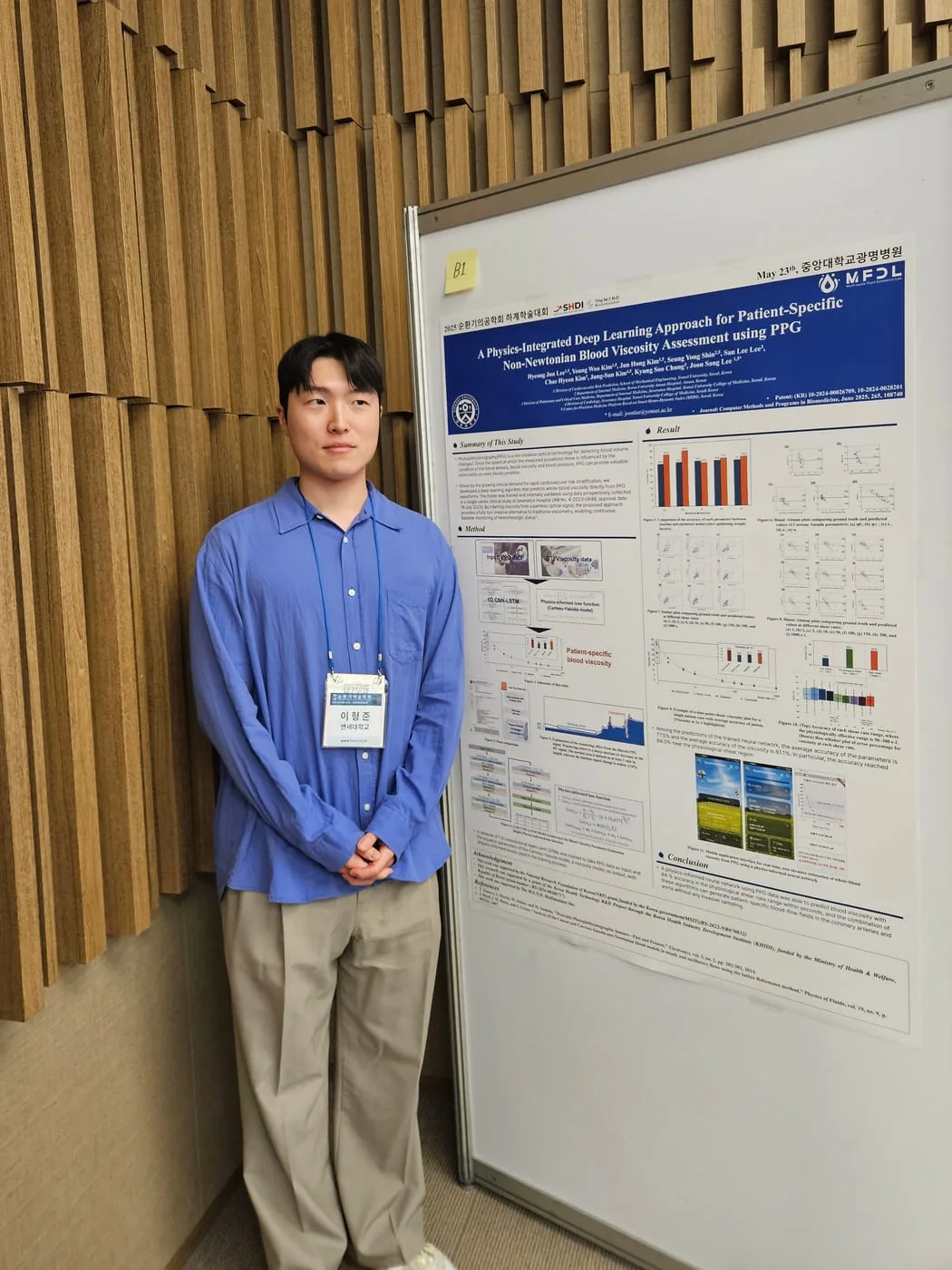
BESCO 2025 · Poster -
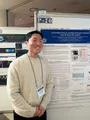
BESCO 2024 · Poster -
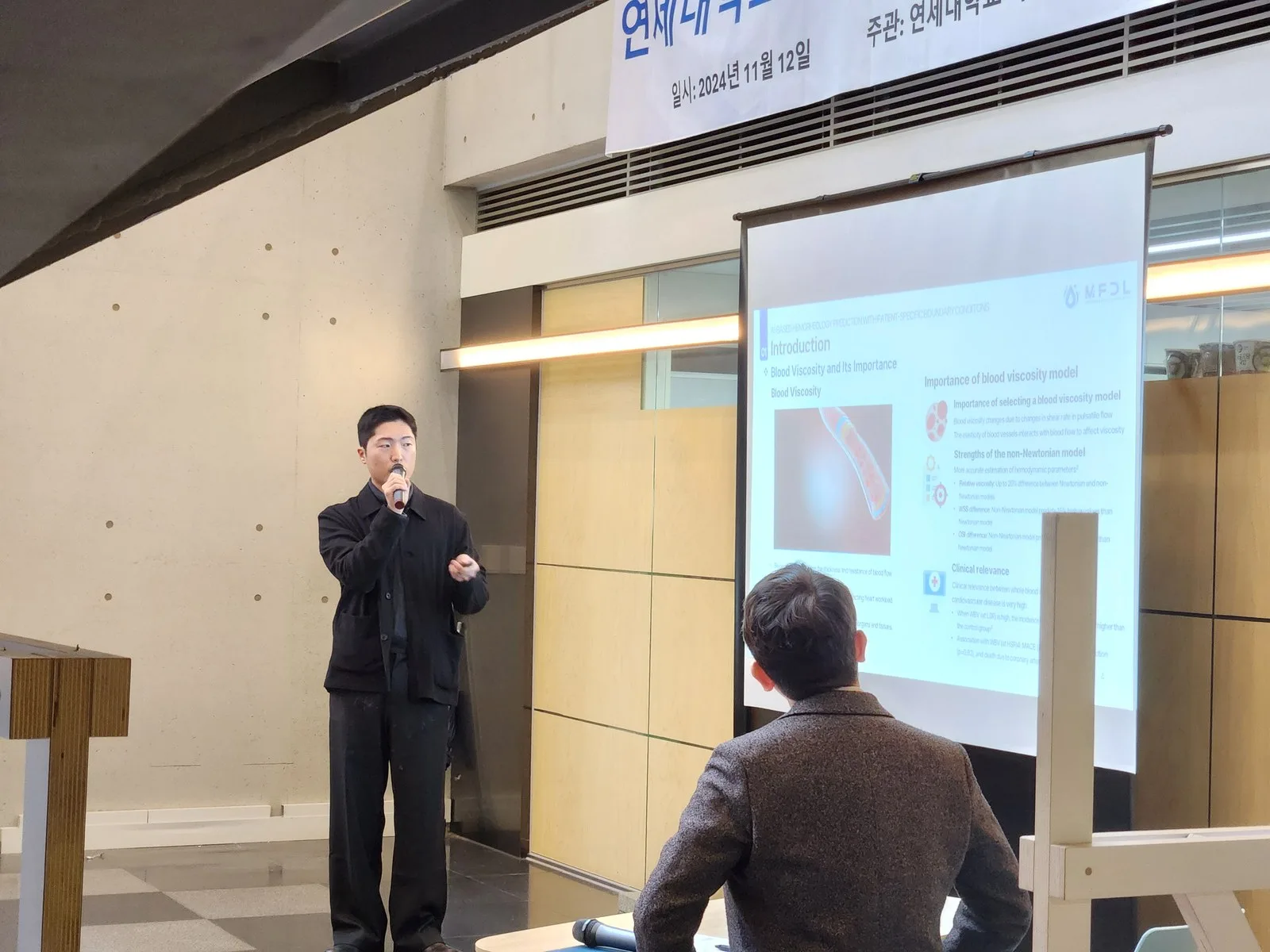
Yonsei symposium 2024
16 talks · 6 international · 10 domestic · 9 presented by me
International
- 2026
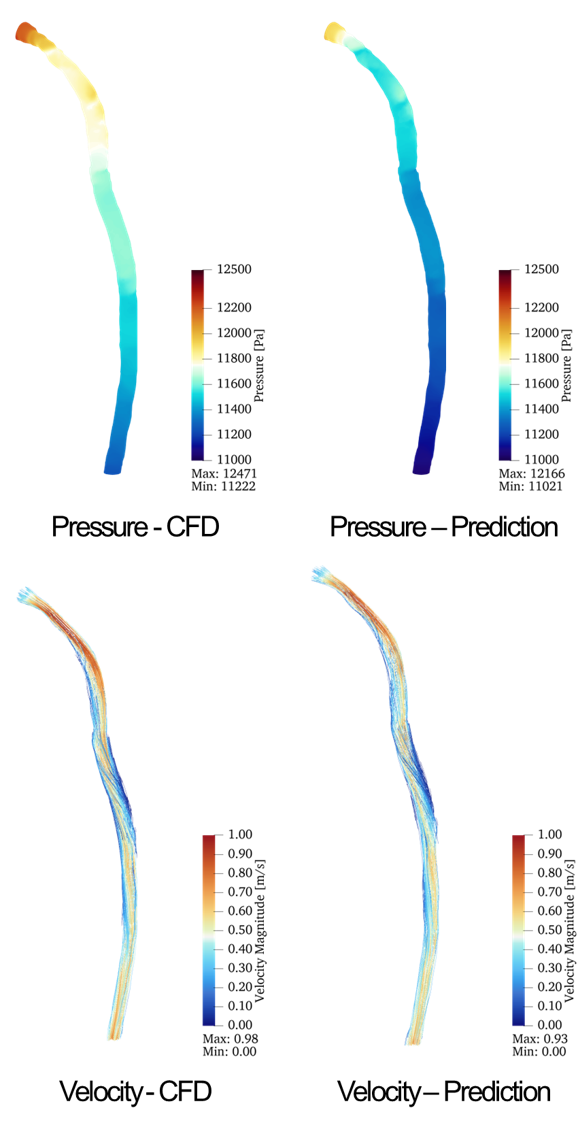
Patient-Specific Coronary Flow Field Prediction Using Physics-Informed Neural Operators
DMD2026 Poster · presented - 2026
Dynamic Fractional Flow Reserve from 4D Coronary CT Synthesized by a Diffusion Model T.H. Han et al. (incl. H.J. Lee)
DMD2026 Poster · co-author - 2025
Patient-Specific Coronary Flow Field Prediction Using Physics-Informed Neural Operators
ACFM Oral · presented - 2024
AI-based Hemorheology Prediction with Patient-Specific Biometric Boundary Conditions
ICTAM Short oral & poster · presented - 2022
Optimization of Artificial Intelligence Algorithms for FFR Prediction in Gray Zone H.J. Lee, J.S. Lee
ICMTE Oral · presented - 2021
Estimating CFD-based CT FFR using lattice Boltzmann method – 3D geometry auto segmentation and novel patient-specific computation
ESCHM-ISCH-ISB Oral · presented
Domestic
- 2025
A Physics-Integrated Deep Learning Approach for Patient-Specific Non-Newtonian Blood Viscosity Assessment using PPG
BESCO Poster · presented - 2025
Time-resolved Coronary Flow Visualization from Single-phase CT T.H. Han et al. (incl. H.J. Lee)
BESCO Poster · co-author - 2024
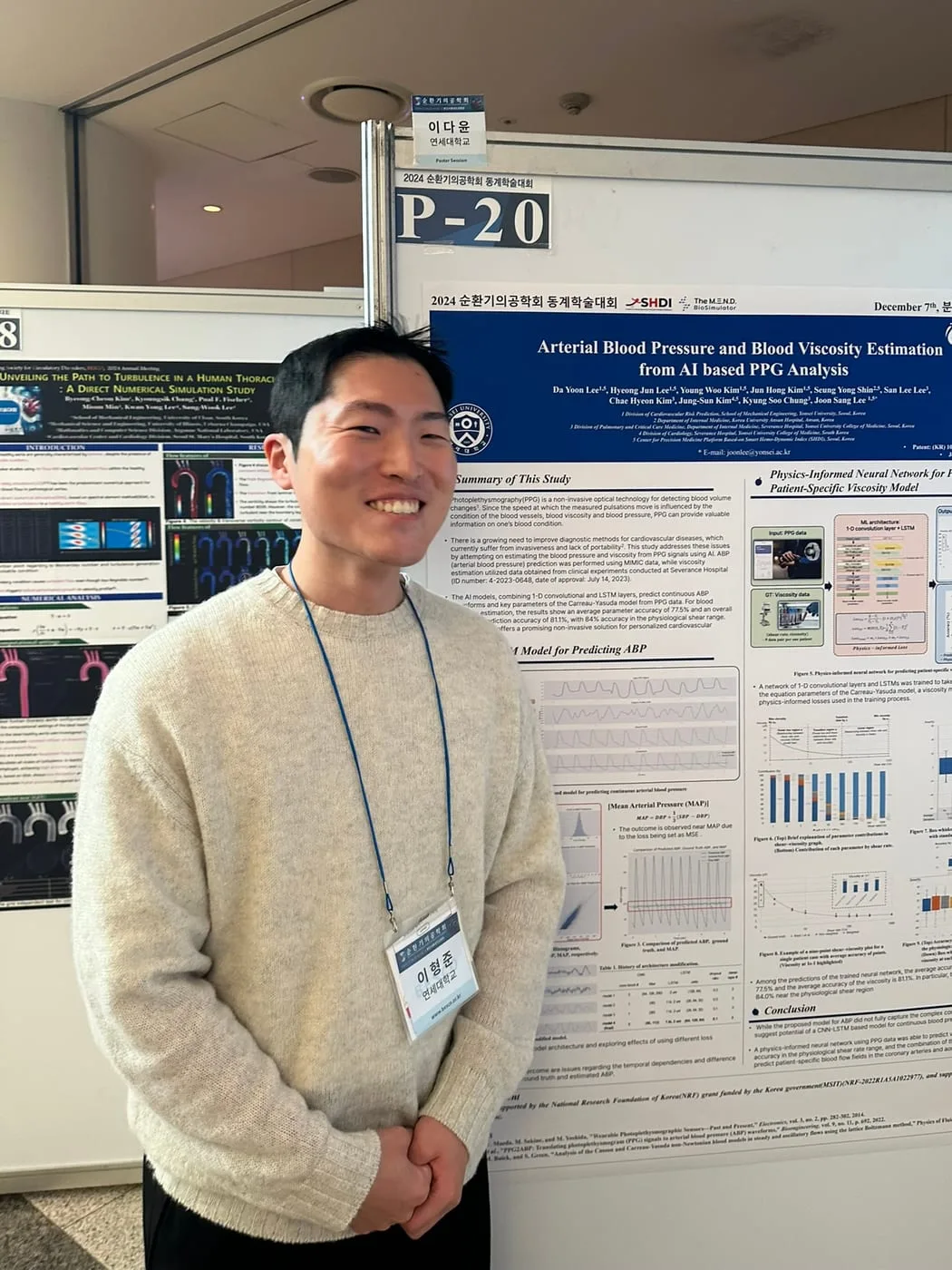
Arterial Blood Pressure and Blood Viscosity Estimation from AI-based PPG Analysis D.Y. Lee et al. (incl. H.J. Lee)
BESCO Poster · co-author - 2024
FFR Prediction with Quantum Machine Learning: Accurate and Non-invasive Diagnosis with Limited Features S.W. Kwon et al. (incl. H.J. Lee)
BESCO Poster · co-author - 2024
Blood viscosity estimation from wearable device using AI-based PPG analysis D.Y. Lee et al. (incl. H.J. Lee)
BESCO Poster · co-author - 2024
Carved membrane design for tricuspid valve regurgitation treatment S.E. Kim et al. (incl. H.J. Lee)
BESCO Poster · co-author - 2023
Unlocking Predictive Health Outcomes with Biometric Data H.J. Lee, J.S. Lee
KSME Oral · presented - 2023
Modeling Coronary Artery Hemodynamics: Exploring DCNN Surrogate Models in Preliminary Research
BESCO Oral · presented - 2022
Artificial Intelligence Algorithms for FFR Prediction in Gray Zone by Single-view Angiography
BESCO Short oral & poster; Best Paper Award · presented - 2021
Autonomous Cardiovascular Hemodynamics Analysis using Patient-Specific CFD Simulation with Unsupervised Learning-based Coronary Artery Segmentation J.H. Kim et al. (incl. H.J. Lee)
BESCO Oral · co-author
Patents
16 filings · 2 registered · 14 pending
- P1
AI-based noninvasive urodynamics test method and apparatus
- P2
Optimization system and method of AI algorithm for prediction coronary artery lesions based on FFR
- P3
Patient-specific coronary flow prediction method based on physics-informed neural operators
- P4
Deep learning-based multiphase coronary CT interpolation system and method
- P5
Deep learning-based multiphase coronary CT interpolation system and method
- P6
Device and method for predicting viscosity using AI in a viscosity prediction system
- P7
Device and method for predicting viscosity using AI in a viscosity prediction system
- P8
Deep learning-based multiphase coronary CT interpolation method
- P9
Method for predicting blood glucose and diabetes using PPG signals and biometric information
- P10
Wearable device for monitoring glaucoma suspect and method for monitoring glaucoma suspect
- P11
Non-Newtonian fluid viscosity modeling of patient blood using wearable device-based PPG and biometric information
- P12
Systolic and diastolic viscosity prediction algorithm using wearable device-based PPG and biometric information
- P13
Glucose and diabetes prediction algorithm using wearable device-based PPG and biometric information
- P14
Wearable device for monitoring glaucoma suspect and method for monitoring glaucoma suspect
- P15
Glaucoma diagnosis method and system based on contactless biosignals
- P16
Optimization system and method of AI algorithm for prediction coronary artery lesions based on FFR
Funded projects (participating researcher)
- Jun. 2022 – Feb. 2029
Real-Time Precision Medicine Platform Based on Smart Hemodynamic Indices
- Apr. 2024 – Dec. 2026
4D Coronary Flow Visualization from CT in Real Time (4D CT-FFR)
- Apr. 2025 – Dec. 2028
4D Flow-Based Diagnostic Device for Dynamic Risk Assessment of Anomalous Origin of the Coronary Artery in Children and Adolescents
- Jul. 2024 – Jun. 2026
Patient-Specific Coronary Artery Disease Risk Analysis Software
- Sep. 2020 – Dec. 2025
Patient-Specific Implantable Device for Tricuspid Regurgitation Using 3D Heart Printing and 4D-CFD Simulation
- Apr. 2022 – Dec. 2024
Variable Negative-Pressure Tunnel for Respiratory Infection Control
- Feb. 2020 – May 2022
High-Speed Point-of-Care FFR Simulator for Cardiovascular Diagnosis and Treatment
Awards and fellowships
- 2026
Merit Academic Paper Award School of Mechanical Engineering, Yonsei University, for the 2025 CMPB paper on PPG-based non-Newtonian blood viscosity assessment (J2)
- 2022
Best Paper Award Biomedical Engineering Society for Circulation (BESCO)
- 2022
Merit Academic Paper Award Yonsei University
- 2022
Best Paper Award School of Mechanical Engineering, Yonsei University
- 2022–2025
BK21 FOUR Graduate Research Scholarship (7 semesters) Fellowship, Ministry of Education / NRF
- 2020–2021
BK21 PLUS Scholarship Fellowship, Ministry of Education / NRF
- 2021
Academic Research Fellowship (ARF) Fellowship, Yonsei University
Teaching
- Mar. 2020 – Dec. 2020
Teaching Assistant School of Mechanical Engineering, Yonsei University
Skills
- Computational
- image-based, patient-specific coronary CFD; lattice Boltzmann method; hemodynamic indices (FFR, wall shear stress); non-Newtonian blood rheology
- Machine learning
- physics-informed neural networks and neural operators (DeepONet/PINO); surrogate modeling; diffusion models; CNN/LSTM; ensemble learning
- Data
- coronary CT angiography (incl. 4D CT); invasive FFR; smartwatch PPG signals; multi-institutional clinical collaborations
- Languages
- Korean (native); English (professional working proficiency)