4D flow risk assessment for anomalous coronary origin in children
2025–2028
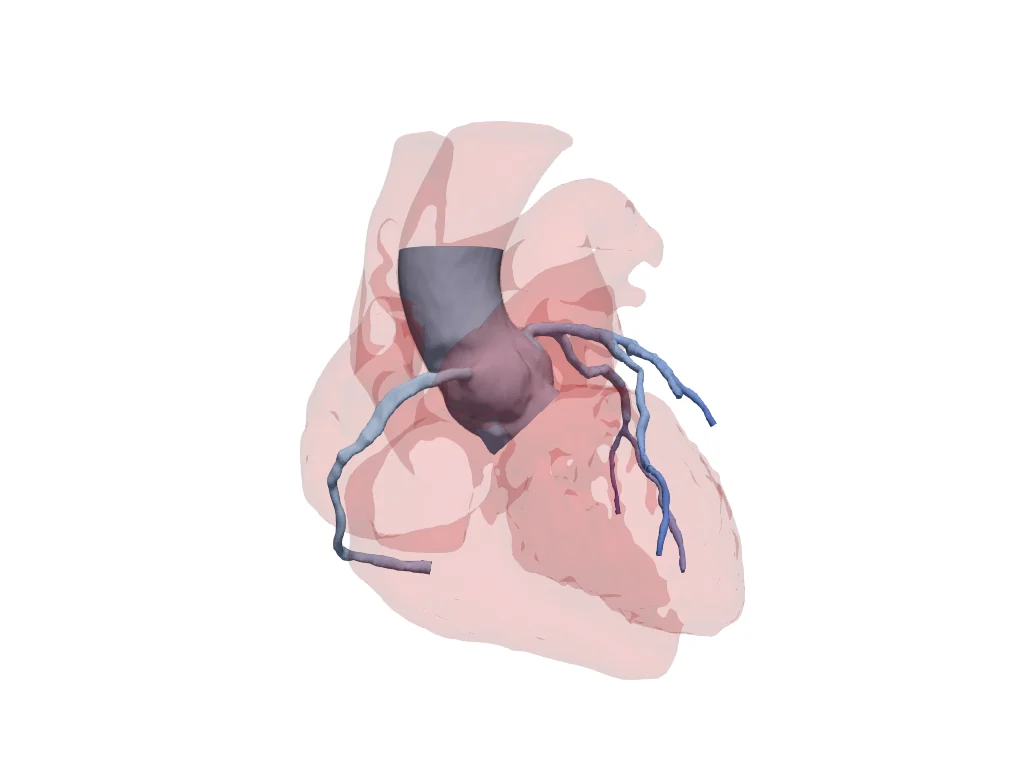
In this device project, 4D flow grades the risk of an anomalous aortic origin of a coronary artery in children and adolescents.
2025–2028
In this device project, 4D flow grades the risk of an anomalous aortic origin of a coronary artery in children and adolescents.
2024 –
A physics-informed neural operator trained on CFD returns a vessel's pressure and velocity field in 1.78 s instead of a 35-minute run.
DMD 2026, first author · patent, pending 2026 · talk, DMD 2026 · talk, ACFM 2025 · +1 talk
A patient's coronary vessel, 8 649 surface nodes: surface pressure from 10.7 to 13.0 kPa, one range for CFD and PINO. CFD is on the left and PINO on the right; slide or toggle to compare.
PINO minus CFD at each node. Here −0.2 to +0.6 kPa, largest at the throat.
Speed one node inside the no-slip wall; inlet and outlet caps masked.
A geometry-informed neural operator returns pressure and velocity at all ~80k volume nodes from the vessel surface alone, with a Navier–Stokes residual in its loss. Every case is predicted by a model that never saw it.
| Metric | This case | Cohort median, n = 85 |
|---|---|---|
| Pressure R² | 0.963 | 0.898 |
| Pressure MAE | 0.1 kPa | 0.2 kPa |
| Speed R² | 0.846 | 0.756 |
| FFR, Pd/Pa | CFD 0.830 · PINO 0.824 | MAE vs CFD 0.038 |
2024–2026
Two acquired CT phases become a full cardiac cycle; each synthesized phase is meshed and solved, so FFR is read across the cycle at 90.5 % accuracy against invasive FFR.
CMPB 2026, co-author · DMD 2026, co-author · 3 patents, pending 2024–2025 · KHIDI project 2024–2026 · talk, DMD 2026 · talk, BESCO 2025
Phase 0 and Phase 5 are the two acquired CT phases (end-diastole and end-systole); phases 1–4 and 6–9 are synthesized by the diffusion deformable model and then solved with CFD.
Pressure70130mmHg9.3–17.3 kPa
Wall shear stress05Pa
A diffusion deformable model synthesizes the full cardiac cycle from two acquired CT phases. Each phase is meshed and solved, so FFR is followed across the cycle instead of read from one still.
| Metric | Value |
|---|---|
| 4D CT-FFR accuracy against invasive FFR | 90.5 % |
| Synthesis PSNR | 32.01 |
| Synthesis SSIM | 0.937 |
| Synthesis Dice | 0.973 |
2024 –
Thirty CNNs read PPG spectrograms and a weighted average predicts an intravenous fluid bolus within 24 hours of emergency-department arrival (AUC 0.895).
manuscript under revision (EAAI), first author
Smartwatch PPG is filtered, cut into overlapping segments and turned into STFT and CWT images; the 30 CNNs score each segment and the scores are pooled per patient.
| Set | AUC [95 % CI] | n |
|---|---|---|
| Development, out-of-fold | 0.895 [0.839–0.940] | 195 |
| Same-center temporal set | 0.827 [0.746–0.898] | 141 |
2024–2026
In this SME-funded software project, a patient's CT becomes hemodynamic risk indices.
2023–2025
A physics-constrained CNN–LSTM with a Carreau–Yasuda prior estimates a patient's non-Newtonian blood viscosity from PPG and basic biometrics; the paper received the Merit Academic Paper Award 2026.
CMPB 2025, first author · 4 patents, pending 2024–2025 · talk, BESCO 2025 · talk, ICTAM 2024 · +2 talks
2023–2024
PPG and contactless biosignal models estimate blood glucose and diabetes risk and flag glaucoma suspects; they are filed as patents.
2022–2029
This seven-year NRF Leading Research Center project studies hemodynamic indices for real-time precision medicine.
2022–2024
This KHIDI project develops a variable negative-pressure tunnel for respiratory infection control.
2022
A registered patent covers a non-invasive urodynamics test method and apparatus.
2020–2022
An AI algorithm combines hemodynamic features, synthetic vessel models and biometrics to call the FFR gray zone; it is published and patented, with a quantum-ML follow-up.
CMPB 2022, co-first author · patent, registered 2025 · patent, pending 2022 · talk, ICMTE 2022 · talk, BESCO 2022 · +1 talk
2020–2022
Image-based, patient-specific coronary CFD runs on a lattice Boltzmann solver after automatic 3D segmentation.
2020–2022
This NRF project works toward a fast FFR simulator for diagnosis and treatment at the point of care.
2020–2025
CFD optimizes a carved membrane device for tricuspid regurgitation; the goal is a patient-specific implant made with 3D heart printing.
EACFM 2022, co-author · KMDF project 2020–2025 · talk, BESCO 2024